

Tackling Compaction, Salinity & Manure Residue with Bio-Cal®
High-magnesium soils with a history of manure use often struggle with compaction, salinity, and nutrient lock-up. The 2025 Bio-Cal trial in Northwest Iowa demonstrated that long-term transformation is achievable.
Neutralizing Excess Magnesium & Salinity
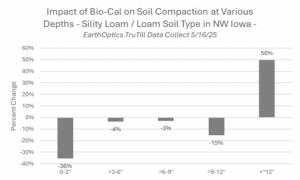
Years of manure application can raise Magnesium and salt levels, compacting soils, and limiting productivity. Bio-Cal targeted these issues by rebalancing the Ca:Mg ratio and reducing pH levels. Treated blocks achieved a healthier Ca:Mg ratio (3.3 vs 8.06) and 10% pH reduction – unlocking root growth and nutrient availability.
The Bio-Cal Advantage: Premium Calcium, Real Results
Bio-Cal’s five-source calcium blend includes fast-acting and long-release forms, delivering both immediate and sustained soil improvement. Unlike commodity lime, Bio-Cal enhances soil structure, water movement, and nutrient access from the moment it is applied.
For lime applicators and growers alike, Bio-Cal is more than a treatment – it’s a foundation for healthier fields, reliable emergence, and strong yields, acre after acre.